

The Realignment Strikes Back
A quick dissection of the April 2025 Wisconsin election

I was right about everything, as always.
Alright, to put it more humbly, my assumption that the political realignment the US has undergone over the past 30ish years is nearing completion, and the consequences of that shift mean that presidential elections every four years are going to lean Republican while midterms, special elections, and spring elections are going to lean Democratic due to a high turnout in high-propensity voters from urban areas, most of whom are more educated, earn more, and are overall more likely to be members of the upper middle class (UMC) and professional-managerial class (PMC).
I am not the only one with this opinion, and I believe my stance on this is backed by hard data, including the actual results of this spring election. Steve Kornacki from NBC had a very similar breakdown on the day of the election (emphasis is my own):
This is a clear advantage that Democrats have carved out in the Trump era. In stand-alone elections for lower-profile offices, in which turnout is far lower than in races for president or even governor, they’ve had the more motivated set of voters. This has been true in Wisconsin, where the Democratic-backed candidate won the most recent Supreme Court election in 2023 by 11 points. And it has been true nationally, where Democrats have posted a string of wins and overperformances in House special elections the last few years.
The energy isn’t coming from all corners of the Democratic coalition. Instead, it is concentrated among a largely white set of voters with high levels of education, higher incomes and intensely anti-Trump views. They are found in most abundance in college towns and metropolitan areas, but even in places where they are few in number, they’ve been punching above their weight in lower-turnout elections.
Here are the actual results, per the NYT for the Supreme Court race:
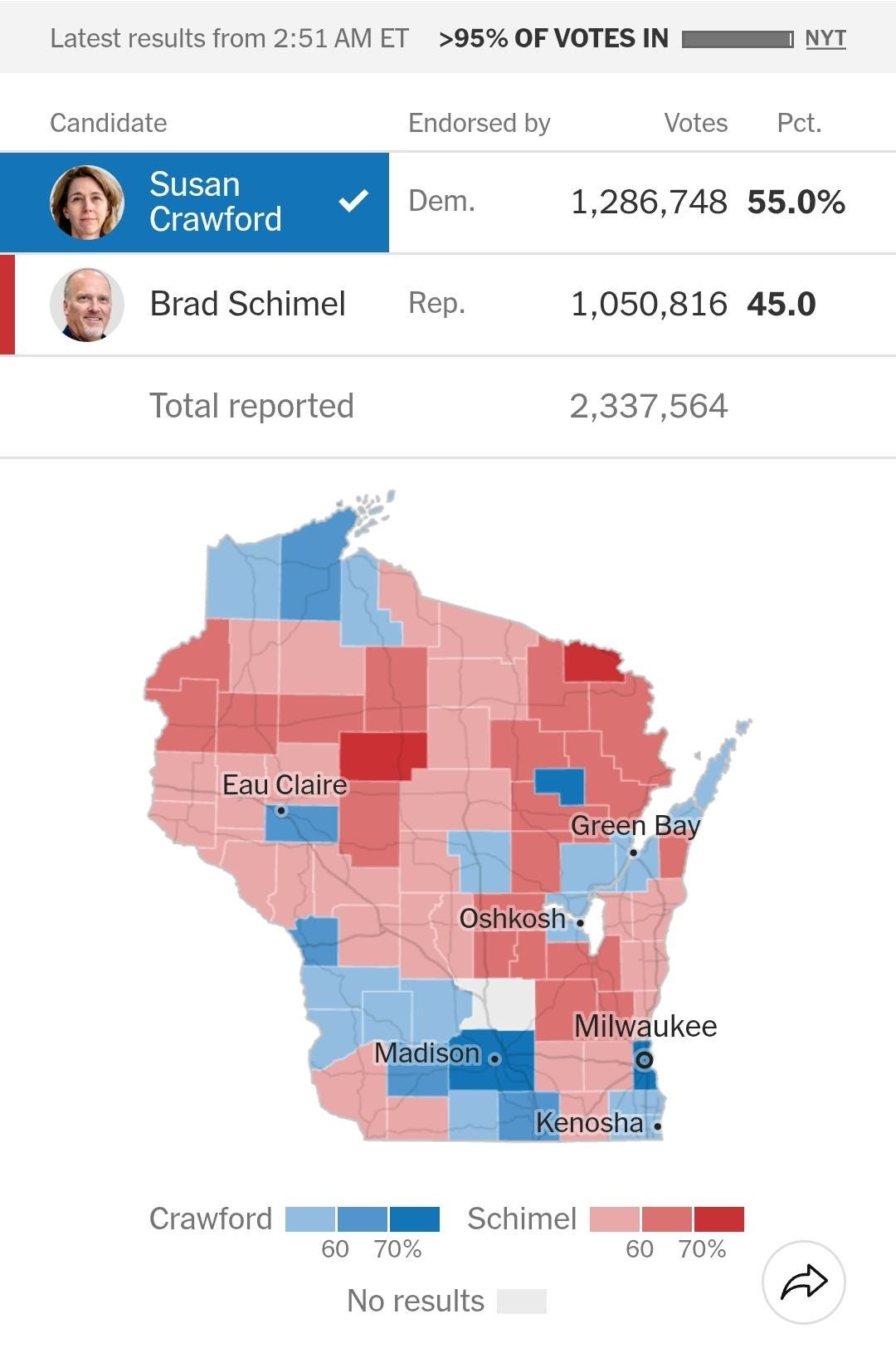
As always, extremely wealthy and educated Madison (Dane County) is deep blue. Milwaukee, which has lots of educated and wealthy folks, and is also a larger metropolitan area by population, also has a larger share of black voters, who still vote disproportionately for Democrats (their role in the realignment is a separate question). Other areas of Wisconsin with larger population centers all went blue: Green Bay, Oshkosh, Kenosha, Eau Claire. The interesting thing here is the shift.
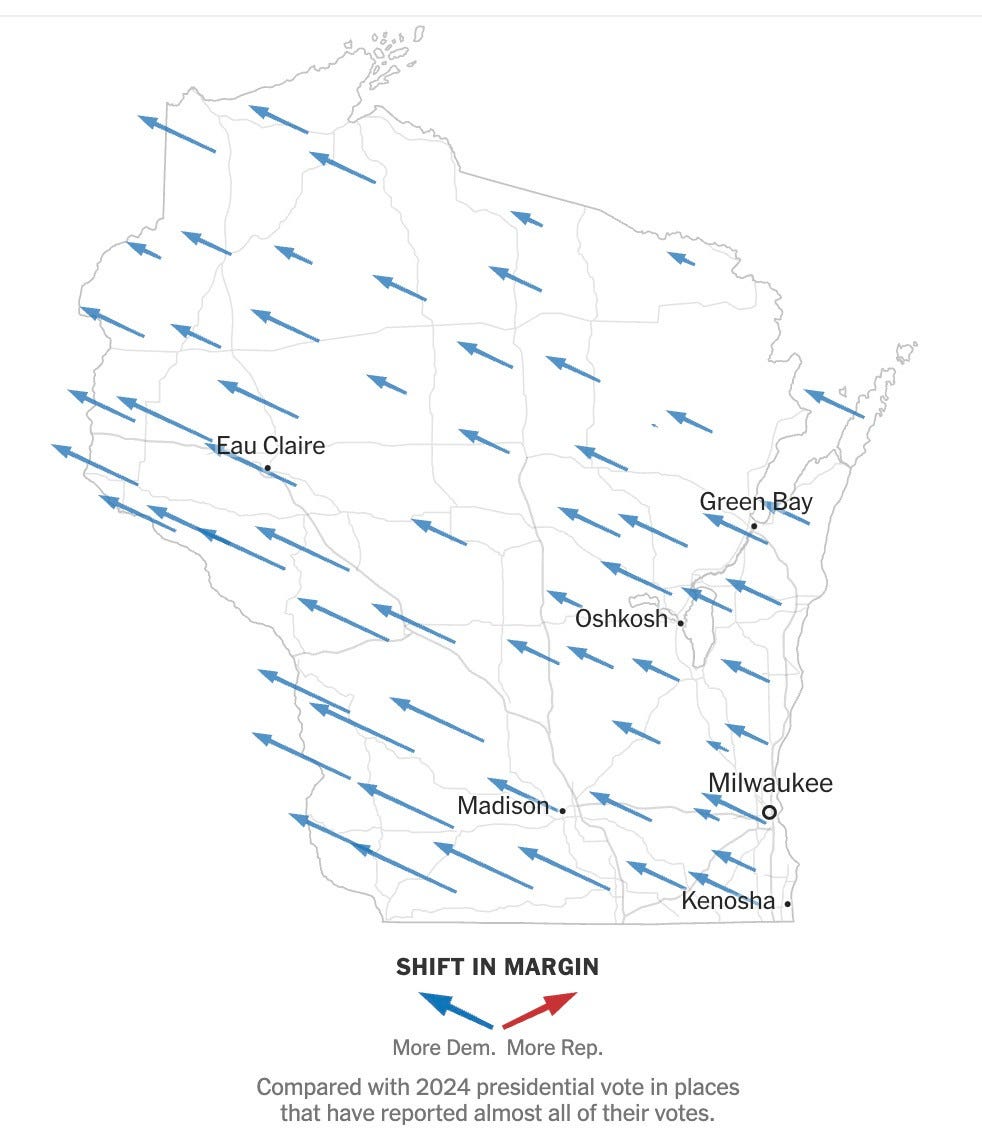
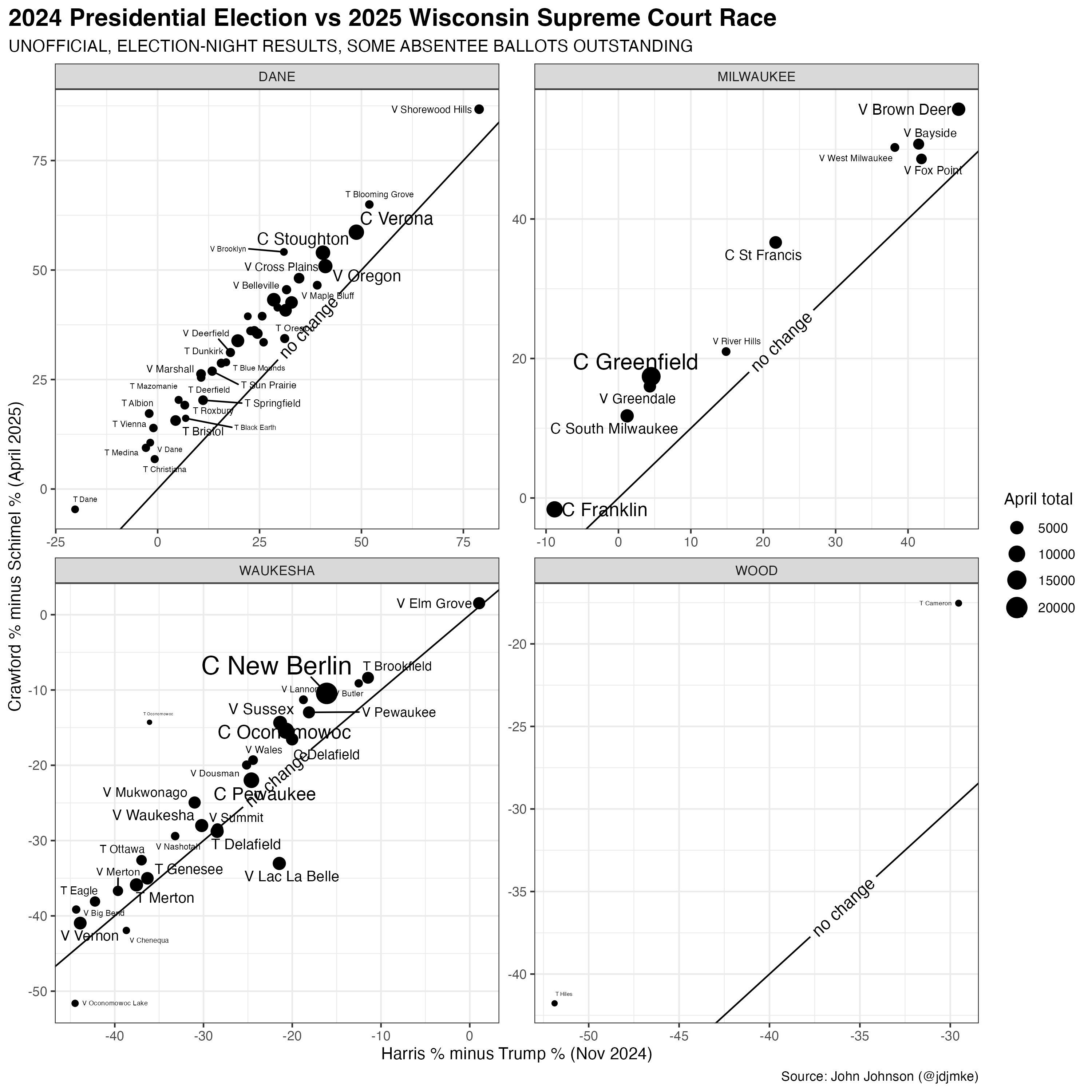
Basically the whole state shifted blue in this election because red voters stayed home and blue voters showed up. Those areas that went for Trump in the presidential election of 2024 voted for him with a margin that was easily flipped in the opposite direction in this election. I think this pattern will continue to show itself in the upcoming midterm elections, which will have a higher red turnout than April 2025, but will still be lower than November 2024. That means that the Democrats are likely to do well. Exactly how well depends on specific circumstances (who is up for election and where), but the foundational turnout numbers and their blue/red split seems to me relatively reliable.
There’s no point in calling these voters liberal or progressive or conservative or right-wing. This is a blue team vs red team political climate and ideologies play little role in how people vote. The red team now has, as a proportion of their whole voter base, more people without a post-secondary education, more people who are working class, more people who don’t pay close attention to current events, and consequently don’t pay attention to any election that isn’t the big one. The blue team is now heavily white, urbanized, educated, higher-income, and really care about what’s happening in the news. They are willing to register to vote, they are willing to request absentee ballots, and they are willing to take time out of a rainy Tuesday in April to stand in line and cast a ballot for… who was it? The governor? No, that doesn’t sound right, I would have heard of that. Maybe a representative? Does that matter much? Oh, a Supreme Court justice? I thought they were picked by the president? Oh! The Wisconsin Supreme Court. Jesus Christ, who cares?
I’ll tell you who cares. A white woman who goes out to brunch with her girlfriends on Sunday and gossips about everything from A to Z, including the disgusting things that Trump is doing over mimosas. Someone who got politically polarized not only by the 2016 presidential election, but by Act 10 in 2011. You know who doesn’t care? A dude working construction. Someone who doesn’t want to register to vote because it makes it more likely he gets called for jury duty. Someone who doesn’t think jury duty is an important part of civic engagement. Someone whose political position is more akin to a belief in a conspiracy theory than a worldview based on hard facts. It not just that these people vote for different candidates, it’s that one of them votes often and the other one doesn’t.
Did Elon Musk play a role?
Kind of.
Too many people are taking this as a referendum on Trump and Musk, specifically the latter, because he poured a lot of money into the Supreme Court race and personally visited Wisconsin to promote the red team candidate. I do not think Crawford won because Wisconsinites were so appalled at Musk’s rhetoric or actions that they ended up voting against him by voting for Crawford. I do not think anyone was actually swayed to one side or another by Musk’s involvement in the campaign.
Looking at the turnout for the April 2023 election, which was also headlined by a Supreme Court race between Janet Protasiewicz (the blue candidate) and Daniel Kelly (the red candidate), the blue team won by almost the exact same 200,000 votes.
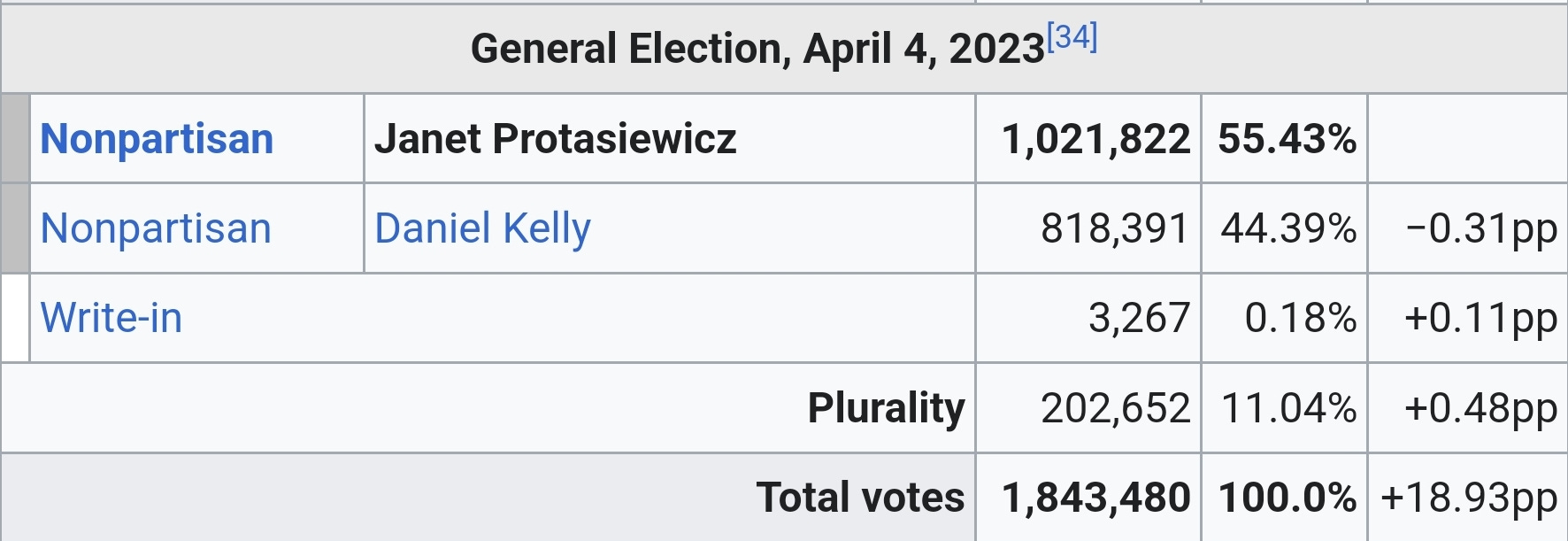
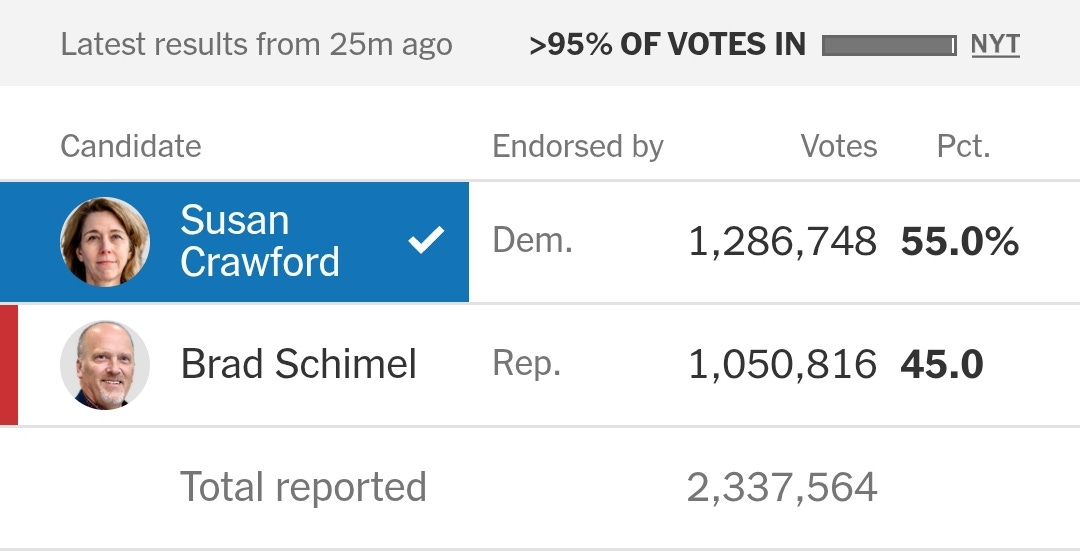
The big difference between the two elections is the turnout. 2025 had a an increase of about 500,000 voters, which is actually pretty big for a spring election like this. I would say that Musk’s involvement is only one part of the broader nationalization and polarization of local politics. The added focus from mass media, extra money poured in to the state from both sides, and consequent increase in salience of the election for the average Wisconsinite simply led to more people voting. But more people voting is a double-edged sword. Who is voting? I return to what I said above; high-propensity, reliable voters are now more blue team than red, so raising the importance of an election will not only increase red team turnout, it will increase blue team turnout as well. And the only time the red team is going to overwhelm the blue team in numbers (and the red team is more numerous) is during a general election.
While midterms are a decent election to use as a “referendum” on the incumbent president, these random spring ones are not. The turnout is simply too low, no one voting feels like they are casting a ballot against Donald Trump. Even when the midterms do come around, at least for this presidential term, it’s going to be hard to read into the tea leaves because Trump is a lame duck, he’s an outgoing president, this is his last term. The results of the midterm might scare the Republican party, assuming they lose big, but they’re not going to change Trump’s tactics because he’s entirely disconnected from feeling the repercussions of a midterm loss. Elon Musk is even more insulated; what does losing this election mean to him other than whatever he comes up with in his drug-addled brain? I simply find it hard to imagine a Wisconsin voter who either changed their vote due to Musk’s involvement in this election. I find it easier to imagine one who voted instead of staying home, but for each red voter that turned out, a one point zero one blue voters turned out too, which tells us nothing about the general public’s sentiment.
What does the voter ID referendum tell us?
There was a referendum on the November 2024 ballot that asked voters to enshrine in the Wisconsin constitution the legal mandate that only US citizens be allowed to vote in elections. On the April 2025 ballot, there was a referendum that asked voters to similarly codify a requirement to show ID when voting. Both passed with overwhelming support. The citizenship referendum of 2024 had a bigger margin for Yes versus the ID referendum of 2025, but in both cases hundreds of thousands of blue voters split their vote between voting for blue candidates and “red” referendum answers.
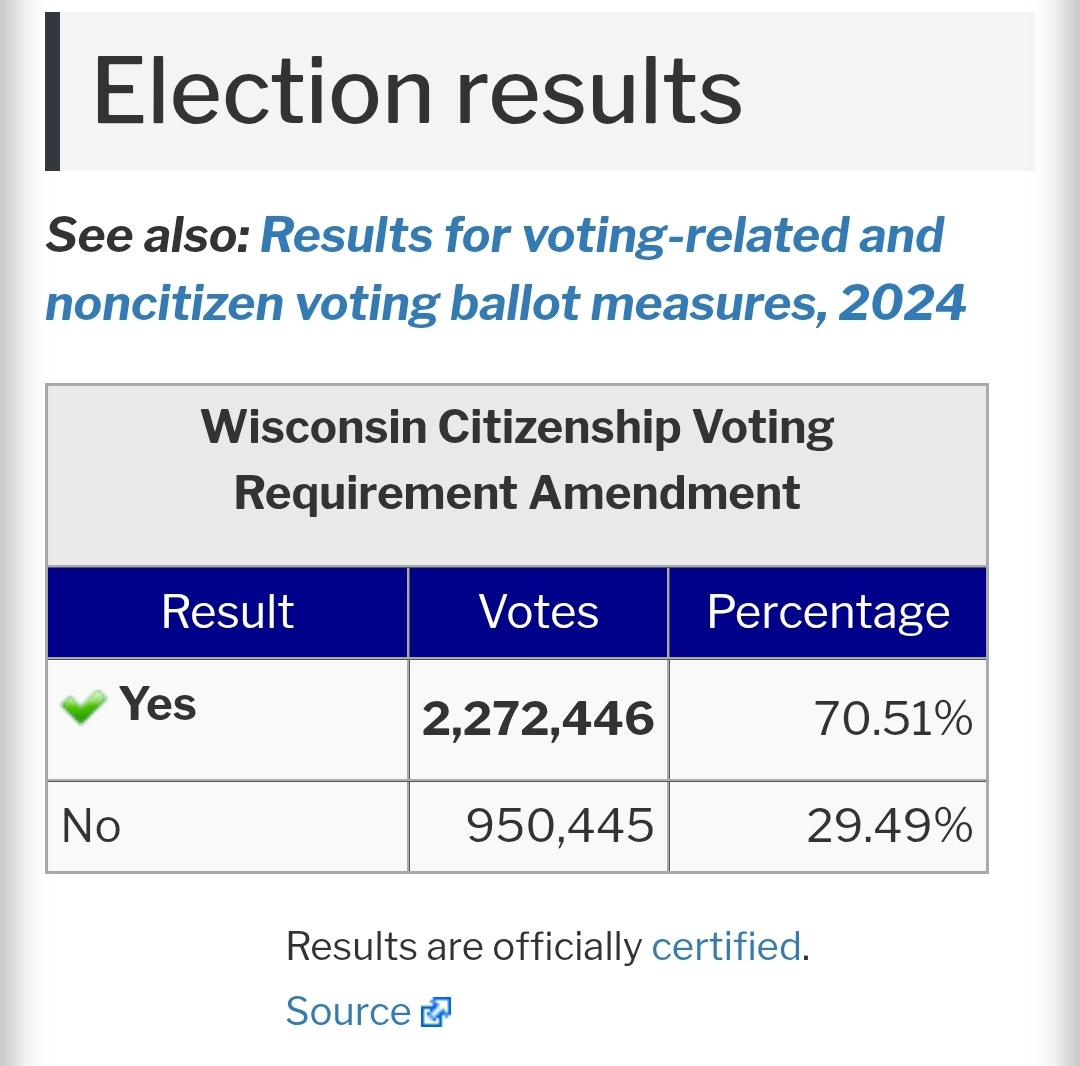
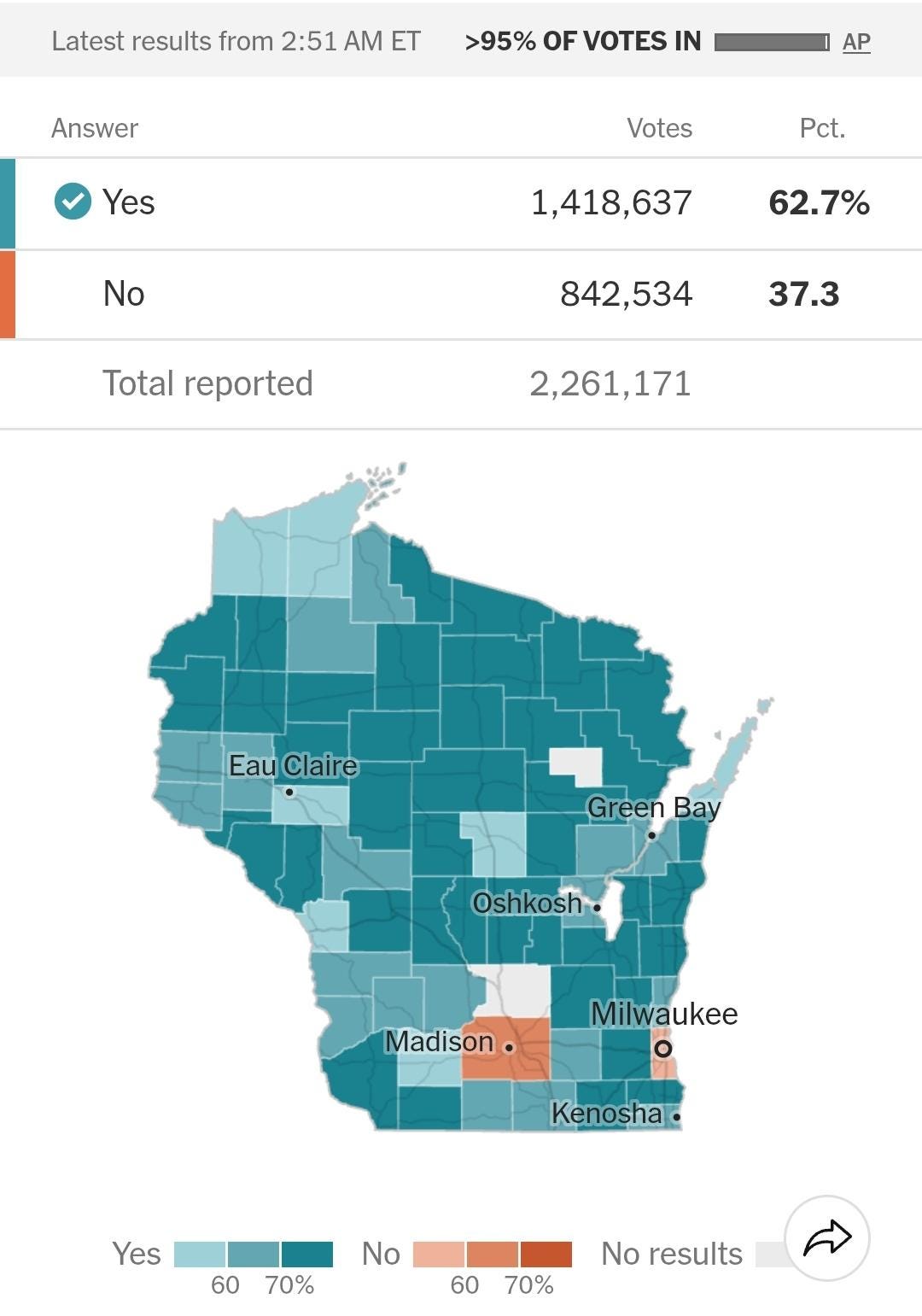
These referendums are political in origin and nature. They are old-school Republican demands that rest on an assumption that there is widespread voter fraud happening in the US and that non-citizens are cheating the system to cast ballots for Democratic candidates. If a red voter is truly partisan, he votes red down the ballot, including voting Yes on these two referendums. A blue team partisan should then vote No on both. Instead, we see that many blue team voters are willing to vote Yes on these requirements. What’s happening here?
I have been open about my prognosis that the realignment will make the Democratic party more elitist and the Republican party more populist, which means that the Republicans will abandon their old-school views on “voter suppression” and the Democrats will pick it up. I am planning on writing about this separately.
While these contrasting election/referendum results seem to support my view — after all, blue team voters just agreed to restrict voting in some capacity — I actually think this is not what’s happening.
While I do believe these Republican-led referendums are vestigial traits from a bygone era (and the red team would be wise to recognize that sooner rather than later and start making it easier for the rubes to vote en masse), what’s happening here is what I like to call the normie vote. Normies are people who think that it’s fucked up how Derek Chauvin killed George Floyd and think that the mass riots in the summer of 2020 were fucked up. They think that abortion is murder and think that abortion should be legal. They think that illegal immigration needs to be reigned under control and think that inhumane deportations are wrong. Normies thought of Covid as a legitimate threat and they got the vaccine plus the first boosters, but they also think that some of the restrictions, especially with schools, went too far (and they haven’t gotten the vaccine again). Normies don’t really like Trump, even if they’re willing to vote for him because of inflation (2024), but they think that January 6th was fucked up.
In general, normies are willing to vote both ways, red and blue. They’re not ideologically committed to one of the two teams, and they’re willing to play the middle to get what they want. Their voting patterns may seen contradictory and it’s hard to nail down what their views are, and that’s largely because they’re normal. In other words, they haven’t descended down the radicalizing rabbit hole of internet-driven political polarization. Which is why, when faced with the question “should we make it constitutionally required that only US citizens are allowed to vote?” their answer it “no, duh.” Like, of course only citizens should be allowed to vote? Who would be against that?
Explaining to them that it’s already legally required to be a US citizen to vote, that you don’t need a constitutional amendment to Wisconsin’s founding document to ensure that, doesn’t do anything to sway them. OK, they answer, but what’s the problem with writing it in the constitution anyway?
The voter ID referendum has a bit more political polarization that tags along. No one from team blue is going to be able to argue for allowing non-citizens to vote, but requiring ID has been a long-standing debate in American politics. The common argument from team blue is that not everyone has ID, and requiring it when voting is going to disenfranchise the vulnerable. Or, as they probably word it, “this is literally erasure of BIPOC and LGBTQIA+ folx,” or something. Black and brown bodies, voters of color, you know the drill.
Even so, while more team blue voters were willing to back the blue position on the ID referendum than the citizenship one, there were still massive numbers of people who voted both ways because they’re normal. They don’t think that requiring an ID to vote is such a massive burden that it’s one we should avoid imposing (and they are correct). If they were to design a voting system from scratch right now, they would absolutely have ID as a part of the requirement to cast a ballot. They look at other Western countries, particularly Europe, and see lots of ID requirements and ask why we can’t do the same in the US. Low numbers of actual voter fraud don’t dissuade them from making voting just a little bit more secure.
While I am not technically a normie by definition, I do vote like one. I am one of those Wisconsinites who voted for Crawford and voted Yes on the ID referendum.
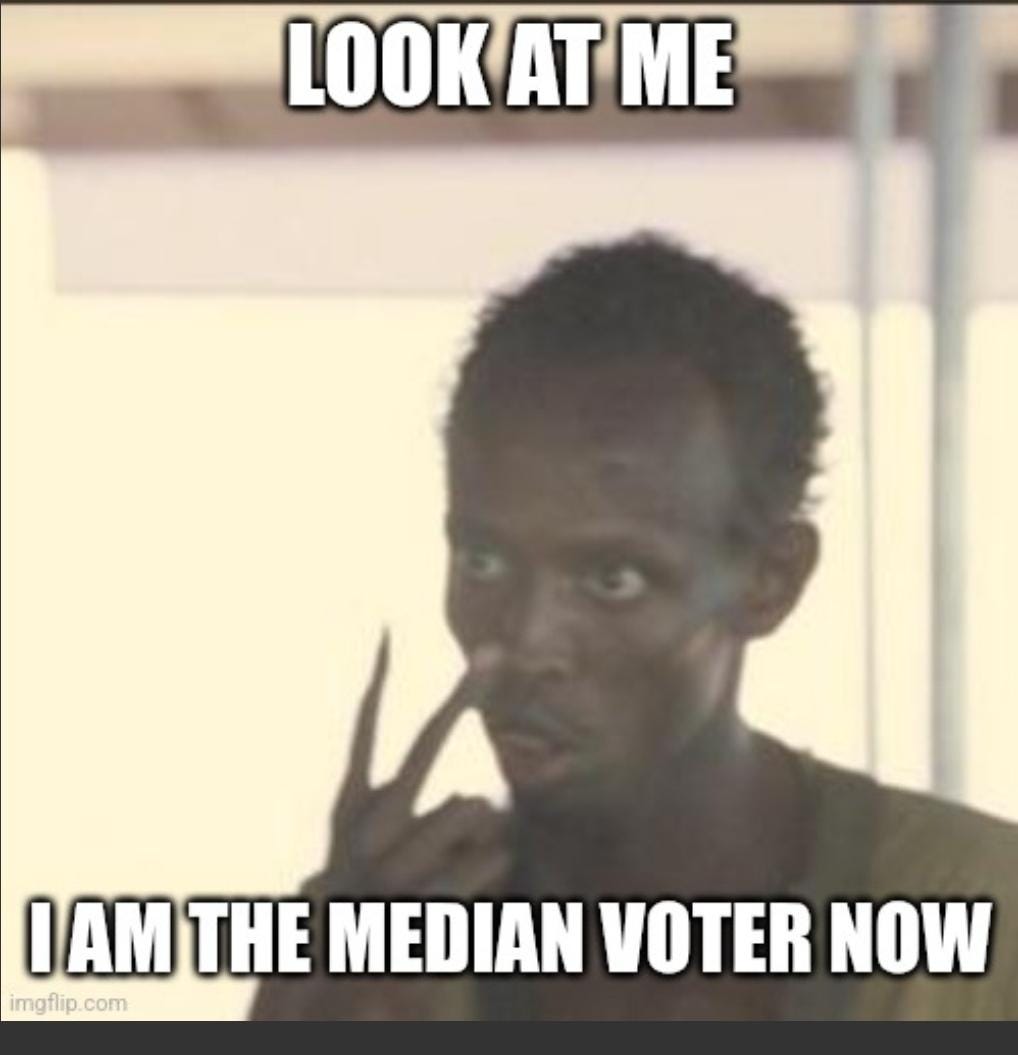
My prediction for future elections in Wisconsin and across the US continues to be that general elections headlined by the race for president will favor team red because the plebeian masses, the hoi palloi, the salt of the earth (you know, morons) are red-leaning and all other elections are going to favor team blue because the latte-sipping elites who listen to NPR care about politics more often and more consistently.
Do you think we could crowd-source Glenn Grothman's defeat? I think that if one started with a question like, "What do Wisconsinites in this 'safe Republican' district need?" and built a local third party around the answers, with a hand-picked candidate, one could easily engineer Grothman's defeat. And, likewise, defeat other Republicans. Note that just one or two such victories would create a swing element in Congress. This is what people disaffected with both parties should be working on. I am completely disillusioned with the parties and I'm scarcely alone.